0
0
Archeologists of Yamal told for what and of what ancient northerners had made armors
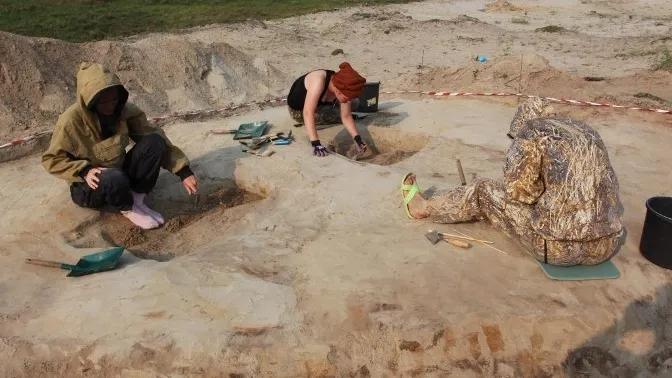
On the 3rd of April archeologists of Yamal participated in the 4th All-Russian scientific conference “The Man and the North: anthropology, archeology and ecology”. It was organized by Tyumen Scientific Center of the Siberian branch of the RAS, the Institute of Problems of Development of the North and the Russian Foundation for Fundamental Research.
The forum gathered the wide circle of experts and scientists of humanitarian and natural-scientific directions. The scientists from Salekhard presented the series of subjects on ancient and medieval history of the north of Western Siberia and Yamal reconstructed on the basis of study of archeological monuments, as the scientific center for study of the Arctic informs. A senior researcher of the sector of archeology of the center for study of the Arctic Andrey Gusev informed the scientific community about the results of study of fragments of ancient armors from the monument Ust-Poluy with the age about 2000 years old. The armors were preserved in the form of separate plates made of reindeer antler. These finds are unique, as such items of organics were preserved hardly anywhere, except Ust-Poluy. The scientists do not know the general look of the armors. Difference of forms and ornaments, in the opinion of Andrey Gusev, speaks that creation of such warriors’ outfits was a sustainable tradition for their time. According to the row of signs, the archeologist makes a conclusion that the armors were made according to the own technology of masters of Ust-Poluy and were not borrowed from other peoples. The report of the scientific researcher Andrey Gusev includes finds received in the course of researching of burial places of the medieval necropolis Zelyoniy Yar, which were dated with the VI-VIII and XIII-XIV centuries. The scientist presented the results of understanding of the important role that was given to iron axes and copper cauldrons in the funeral ritual. Use of these objects reflected the important ideological role that was given to them by local population. The conducted analysis points to deep roots of this custom, which existed in this or that form up to the present day. The report of a senior researcher Andrey Plekhanov includes the first results of the work on the multilayer monument Ngarka-Yedyotayakha-1 in the south of the Yamal peninsula. The archeologists set that in the ancient time people had visited this place as minimum three times: for the first time about the birth of Christ and later in the IV-VI and IX-XII centuries. The report of Andrey Plekhanov included information about artifacts characterizing materials culture of that period of time. According to the scientist, within the excavations the specialists managed to receive very interesting information about everyday life of the local population, in particular, processing of iron, which had been fulfilled here in later time. An object calcinated in the result of high temperatures and also slag, fragments of clay nozzles and fragments of walls were found here. It confidently speaks about work of a temporary smithy at this place. Perhaps, a part of items was made here and a part was taken away. This aspect of knowledge of medieval population is very poorly studied. Thus, the new data will allow advancing considerably in understanding of how life of ancient people of Yamal was organized.
0
0
Теги: