0
0
Scientists studied migration paths of polar bears on Vaygach Island
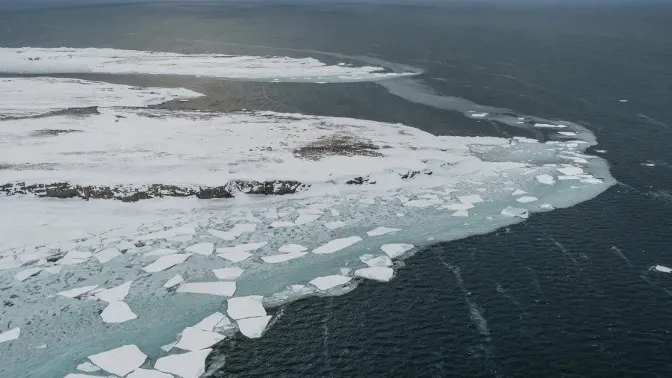
The helicopter expedition organized by the WWF-Russia Barents Sea office studied migration paths of polar bears in the north of the Nenets Autonomous Okrug. During three days the scientists examined the territory in five thousand square kilometers. Like last year they chose a part of the coastline between the village of Amderma on the coast of the Kara Sea and Vaygach Island, where in spring polar bears begin to migrate after the end of the polar night. A year ago the members of the expedition put a collar with a satellite transmitter on a she-bear and also conducted a series of observations over behavior of ten polar bears. This year the specialists flew around Vaygach Island, reached the south of Novaya Zemlya and reviewed ice fields in hope to repeat the success. However, the weather conditions in April this year were quite different than expected, as it is informed in the press service of the WWF-Russia Barents Sea office. “Because of the high average temperature on the coast of the Arctic Ocean this year we did not see the land fast ice, on the edge of which polar bears usually find their prey. But the cyclonic wind drove ice from the north-east, which formed many kilometers of ice fields and hummocks. Under these conditions the beasts of prey stayed far away from the coastline, and we saw vast expanses of ice”, as the coordinator of the project of the WWF-Russia Barents Sea office Ivan Mizin said. According to his words, traces of two or three polar bears covered with the wind were lost among the piles of ice. During three days of active search the scientists did not manage to see a polar bear from the helicopter. Only once they found remains of a seal after a successful hunt of the beast of prey, and three times they tried to find the animals by the traces but in vain. Absence of polar bears allowed other animals to feel free in these places. On the edge of large open water areas the scientists saw sea hares, harp seals hiding among hummocks and noticed numerous seals near cracks. In the Kara Strait they saw walruses having a rest on ice floes and several beluga whales in a large ice hole. At last the participants of the expedition saw one bear. A young bear male appeared on the edge of the village, and the scientists participated in organizing of a competent chasing away of the beast of prey. The group on snowmobiles immediately went to the place of detection of the bear, which, without waiting for the patrol, ran away after warning shots up and disappeared among the hummocks. Consultative and practical assistance in prevention from conflicts between the man and the polar bear became another goal of the expedition. For local residents appearing of beasts of prey in the village is not rare, they know what to do. But the experts still conducted conversations and instructions with the local residents. Despite the fact that the goals of the expedition were not fully achieved, the scientists received new data on the number and distribution of marine mammals, dependence of polar bears on ice conditions during seasonal migrations, and the inhabitants together with the experts successfully stopped a possible conflict with the beast of prey, as the director of the WWF-Russia Barents Sea office Oleg Sutkaitis says. As the experts note, they saw numerous flocks of eider ducks and gulls almost everywhere, where there was open water. With change of wind direction the ice will begin to break down, and polar bears will inevitably appear on the shore.
0
0
Теги: