0
0
Green tundra, “thawing” shores. Dynamics of landscapes is being studied in Yamal
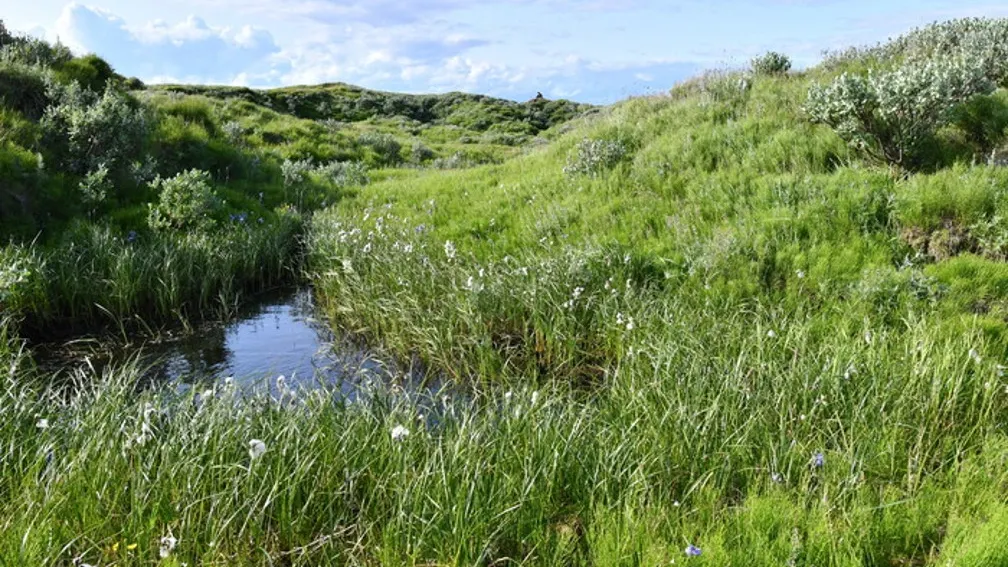
Scientists from the Bio-Geo-Clim Laboratory of Tomsk State University made a film about changing of landscapes in the Russian Arctic. It was edited from materials of filming in Yamal and images from space.
“Within the project supported by the Russian Science Foundation we are studying the phenomenon of high vegetation productivity in subarctic conditions. The received data will become the basis for creation of technologies for environmental engineering in the Arctic zone of the Russian Federation”, said Sergey Loyko, a senior researcher in the Bio-Geo-Clim Laboratory. – “The film on dynamics of landscapes of the typical tundra of Yamal was edited from the materials of filming conducted during the summer expedition in 2019 and various space images from open sources. The starting point for filming was in the settlement Seyakha located at the confluence of the river of the same name in the Gulf of Ob, which is called “The Gate of the Arctic”.
Northern landscapes change very quickly. It is no coincidence that this territory is an indicator of transformations taking place on the planet. Rapid destruction of the shore in the area of the Gulf of Ob is one clear example, as the press service of Tomsk State University reports. Here numerous kinds of ice (lode and formation ones) come to the surface, rapidly thaw, what greatly accelerates the process of abrasion (destruction of the shore). Over the past 13 years the shoreline has moved back almost by 60 meters in some places. The scientists recognize “khasyrey” landforms even more noticeable phenomenon of the changing Arctic. “Khasyrey” is a former lake that was emptied due to thawing of permafrost and thermal erosion of shores. The “khasyrey” landforms become green oases in the middle of tundra and in the future can contribute to development of agriculture in the Far North.
“Changes in the Arctic zone of the Russian Federation, including the greening, are the discrete phenomenon, it affects about 10-20% of the territory, 5-7% of which fall on the “khasyrey” landforms”, explained Sergey Loyko. – “In general, processes that occur in the Arctic are natural, but climate warming since the 80-s has greatly accelerated them. All this is also accelerated with anthropogenic factors: people assist to environmental changes, for example, we found green oases in places, where builders previously took sand for new objects. The disturbed permafrost began to thaw and to give the soil elements of mineral nutrition that were in deep layers. As a result, vegetation not typical of tundra appeared: poppies, chamomiles”.
According to the researchers, people will be forced to rebuild their activity, being based on how the environment is changing. For example, the greening of the Arctic leads to decrease in lichens and reindeer moss “Yagel”, which is the main food for reindeer. Decrease in the amount of the feed base will lead to the necessity to deliver feed. Thawing of permafrost leads to soil movement, what can cause destruction of infrastructure - roads, pipelines, buildings. That factor must be taken into consideration when building new facilities.
The scientists of the Bio-Geo-Clim Laboratory assume that 2020 with its abnormal temperatures will be a serious blow to permafrost. The researchers from the University plan to test their hypothesis during the new field season and the expedition to the Arctic zone of the Russian Federation.
0
0
Теги: