0
0
Vilkitsky Island: polar bears, swimming in icy water and a flock of birds covering the sky
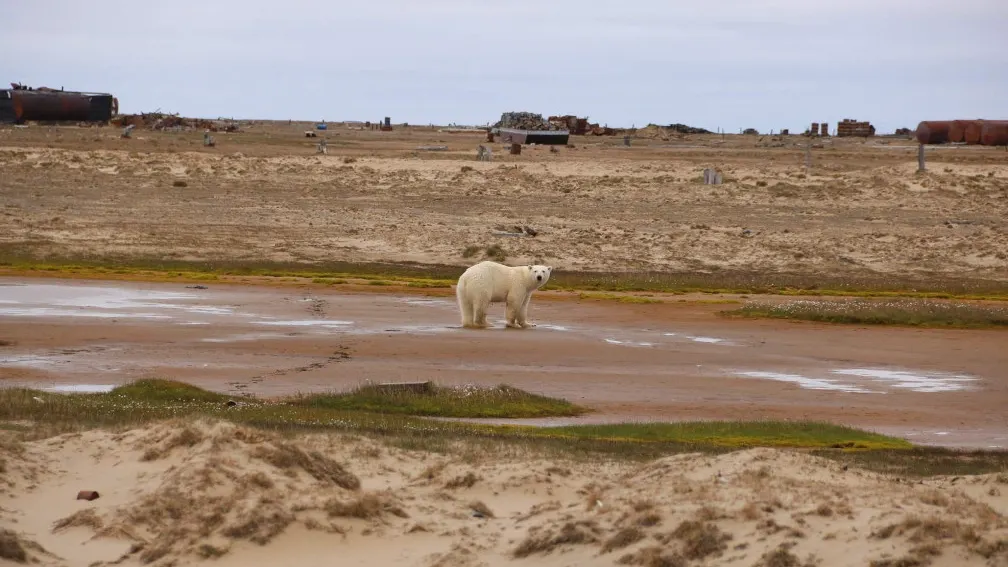
To endure cold and to wear a warm down parka in July, to see icebergs and snow alternated with rain, to swim in the Arctic Ocean – not everyone can have the chance. Alexander Yakovlev, a student of the master’s course of the Industrial University of Tyumen, who studies on the specialization “Business-informatics (the profile – “Information technologies in marketing”, the modular area “Arctic”), had the chance to experience an amazingly exciting adventure. He went to the international expedition for restoration of ecological balance on the territory of Vilkitsky Island.
As it should be noted, the island is uninhabited, situated in the eastern part of the Kara Sea, between the Gulf of Ob and the Yenisei Gulf and referred to the territory of Yamal-Nenets Autonomous Okrug.
According to Alexander, it is difficult to become a participant of the expedition. 180 volunteers from Russia and different countries of the world submitted their applications for participation in the ecological expedition to Vilkitsky Island, but only 30 people went to the coast of the Kara Sea.
“I was just lucky. The selection was very strict. To pass the first stage we should have passed the psychological test and answered 33 questions. After that the remote questionnaire was conducted, and we were invited to Salekhard for the in-person stage. The group of the volunteers includes the participants from Moscow, St. Petersburg, Yekaterinburg, Kazan, Kogalym, Langepas, Uray, Syktyvkar, Nadym, Salekhard, Tyumen, Lipetsk, Omsk, Ukhta and Yaroslavl together with Russian compatriots from Moldova, the Pridnestrovian Moldavian Republic, Kazakhstan and Israel”, Alexander told.
The training camp was organized in July on the bank of the Ob River. Coaches and organizers worked with the volunteers on team-building, tested them for physical and psychological endurance. Elements of training of intelligence units of Russian and Israeli armies were used. Then the volunteers confirmed that they were really ready and able to work in severe climate and geographic environment of the Arctic, without cellular communication with everyday physical load, and also they were ready to help their comrades and to make the world around cleaner and better.
The united team of the volunteers of the Arctic went to Vilkitsky Island on the 11th of July from Salekhard by two helicopters through the settlement Tadebya-Yakha (in translation from Nenets language “the shaman’s river”), where they stopped for additional fueling. When they arrived in the island, first of all, employees of the Ural search and rescue detachment reviewed the territory on presence of polar bears, and after that the team started equipping the module of the former polar station “Horizon” built in 1972. It was designed with consideration of all specifics: two-meter supports in order a bear would not be able to get inside, aluminum and foam panels, triple plexiglass windows.
“This is a real fortress, warm and cozy. But the module is still suitable for accommodation, though conditions of life inside are Spartan. The team cleaned the module and its basic rooms for having a sleep, the participants organized sleeping places themselves, assembling metal bunk beds of the 50-s found in the military unit. For the nearest 30 days it became home for the team surrounded by polar bears”, the student remembered.
According to him, 6 polar bears lived on the island during the expedition. One of them came very often to the module and observed people with interest. First, they tried to frighten it with help of noise, signal rockets, but it got used to them very quickly and did not pay attention.
Among the volunteers there were scientists, who conducted a row of scientific and research observations on the territory of the island. The student of the Industrial University of Tyumen Alexander Yakovlev became their assistant. He remembers the case, when he together with an ornithologist (on the island it is forbidden to walk alone only in groups or by two) collected data on birds residing the island and came across a sleeping polar bear.
“A big bear was sleeping in 150 meters away from us. We glanced at each other and decided to leave unnoticed as far as possible, quickened steps, and somewhere in 500 meters it smelled us and went to us. It reached the middle of the road, stood about 250 meters away from us, and then birds were alarmed and distracted its attention. It ran toward them. I should note that bears run very fast. It jumped up and grabbed one of the birds in mid-flight, pinned it to the ground, and struck it several times until it stopped moving. Then it stood up on its hind legs, turned to us and growled, as if to say that this was its prey and that it was the master here. We, in turn, tried to get away from it as far as possible”, Alexander told.
Bears were mostly in the southern part of the island because of birds nesting there. By the way, they destroy birds’ nests and eat eggs.
The second dangerous meeting with the master of the island took place in the Kara Sea. Alexander and the ornithologist worked in the coastal water.
“We were standing waist-deep in water, and a bear came out at us. It was uncomfortable because the water is its element; it is strong there as nowhere else, and, according to scientists, it always drags its prey into the water, where it has no equal. We immediately realized that the bear was looking at us as at potential victims. Adrenaline was pumping! But nothing happened”, the student shared.
Also he will never forget the event connected with birds.
“On one lake there were about three thousand birds. These are mixed flocks of geese, ducks and loons. Can you imagine?! Three thousand! And then something frightened them, and they flew up in an instant. Have you ever seen a swarm of bees circling in one place? So imagine that this swarm became 30-50 times bigger. The flock of birds momentarily covered the sky above us. It was such a sense that there was an alive and screaming blanket above. It is impossible to see something like that anywhere else”, the student from Tyumen admired.
According to him, within the expedition on the island they managed to find about 30 different species of birds being considered protected. In rare leisure hours the young people collected semiprecious stones – chalcedony and carnelian, trained on horizontal bars. In the evenings they watched movies that had downloaded in advance, since there is no Internet or cellular communication on the island, but there was the arctic cold with the wind of at least 20 m/s, polar bears and tonnes of garbage left from the Soviet times.
“We swam in the Arctic Ocean at the water temperature of 2C degrees above zero. But first, we were prepared thoroughly. Took hot tea, lit the fire on the beach. The water is cold, very cold. I am from Salekhard, used to cold water - it is cold in the Ob River during the whole summer, but the guys from the southern regions had a hard time. Unforgettable experience, of course, you duck under water a couple of times and swim a little. As if the cold fills every cell of your body with thousands of needles, it is impossible to stay in such water for a long time”, he shared his impressions of swimming in the arctic water.
As for garbage collection, the volunteer noted that they had to dig out metal pipes, casks. Most of them were full of wet sand, fuel and lubricants, and only a small part was empty, engines weighing several hundred kilograms, various parts of military equipment, radar stations, cables, fire hoses and many other things. All this stuff was stored on wooden pallets, so that, when the collected metal is moved to the shore for its removal and further disposal, it would not get frozen to the ground.
According to the results of the ecological expedition of 2019, more than 60 hectares of land were cleared on the territory of Vilkitsky Island, more than 200 tonnes of metal garbage and 500 two-hundred-liter casks were collected. They were stored on wooden pallets. Also 20 constructions on the territory of the military unit were dismantled.
Photos by Alexander Yakovlev can be found here: https://sever-press.ru/2019/09/16/ostrov-vilkickogo-belye-medvedi-kupanie-v-ledjanoj-vode-i-staja-ptic-zakryvajushhaja-nebo/
0
0
Теги: